Two new Books on Victoria’s history! September 19, 2026
Stuart Stark, award-winning Heritage Consultant, has written two new books, on the:
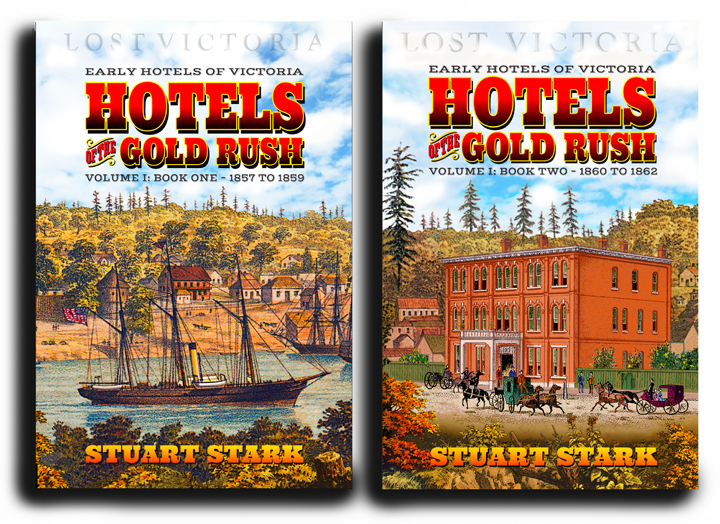
Hotels of the Gold Rush: 1857 to 1862.
BOOK ONE covers the time of the Fraser River Gold Rush, and the hotels built between 1857 and 1859.
BOOK TWO covers the time of the Cariboo Gold Rush, and the hotels built between 1860 and 1862.
Together, the books cover Victoria’s early development over a significant five-year period, as seen through the lens of hotels, their hoteliers, and the many guests – all hoping for great wealth – who entered Victoria’s first hotels and slept in their mostly-uncomfortable beds.
Wide-ranging new research tells the amazing stories of the hoteliers: Where they came from; how they funded building their hotels; and what happened after the Gold Rushes petered out. Epilogues trace the hoteliers’ histories after they left Victoria.
The development of Victoria – physical and economic – is chronicled, including intriguing aspects of the city that still exist today.
Heavily illustrated, footnoted and indexed, these books offer new stories of Victoria’s early hotels.
A book-signing at Munro’s Books will launch the books on Saturday, September 19, from 1pm to 3 pm. Come and meet the Author!
Hotels of the Gold Rush: BOOK ONE 1857-1859 482 pages pages; 331 illustrations; 1,479 footnotes. ISBN 9781775120438
Hotels of the Gold Rush: BOOK TWO 1860-1862 454 pages; 272 illustrations; 1,570 footnotes. ISBN 9781775120421
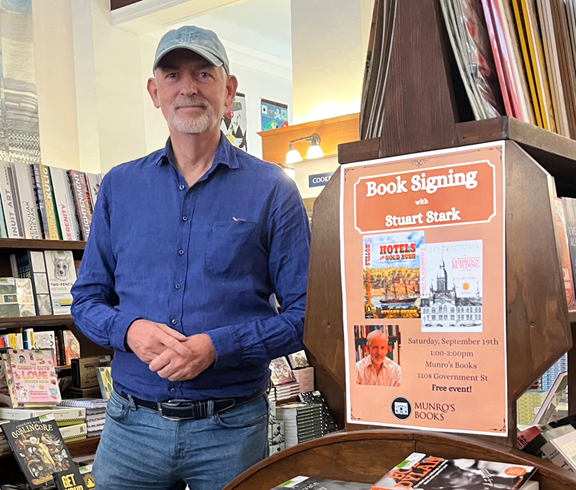
Stuart Stark at Munro’s Books, prior to his booksigning on September 19, 2026
Also available at Stuart Stark’s booksigning will be copies of the Third Edition of:
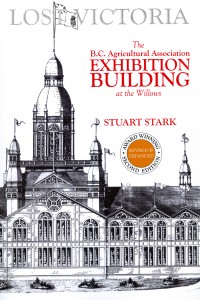
The B.C. Agricultural Association Exhibition Building at the Willows
This book won a Hallmark Heritage Society Communications Award in 2018.
The B.C. Agricultural Association
Exhibition Building at the Willows
Stuart Stark, award-winning Heritage Consultant, tells the grand story of Victoria’s astonishing ‘Crystal Palace’, which was built in 1891 and burned in a night-time conflagration in 1907.
Using social and architectural history, the history of the Exhibition Building is recounted, starting in 1861, when the first agricultural exhibition was held as a means of survival for the people living in the Colony of Vancouver’s Island.
The exhibitions developed and grew, culminating in the construction of the landmark building, built on the fortieth anniversary of its London namesake. The roles of the Secretaries of the Agricultural Association – and the hundreds of private individuals and many city councils who planned, organized and controlled the exhibitions – and the politics that made the building possible provide the compelling background of a little–known building that was important to the lives of early Victorians. Fifty-eight agricultural exhibitions were held over the course of 81 years, through social changes, economic tribulations and two wars, until the last Exhibition was held in 1941.
In an age before emails and computers, the amazing accomplishments of a city are celebrated. Royal visits, wonderful exhibits, horse-racing, circuses, fireworks, sports, sideshows and gold medals frame the story of the Exhibition Building as a place “where everyone could come and do their best”.
The agricultural exhibitions developed from an annual show of animals and produce to a huge fairground showcasing industrial exhibitions, automobile shows and movie production facilities. The city’s own history is reflected in the account of this great building, and the exhibitions that came before and after, allow a unique perspective of a town’s story.
Second Edition. 349 pages. 293 illustrations. Footnotes. Index. ISBN 978-1-7751204-1-4 Softcover. Historic Media. www.LostVictoria.com
Please note: This book has now been re-released in a Third Edition, as of September 2026, with more images and updates.
This book was originally launched on Friday, December 15, 2017 at 2 p.m. at the Oak Bay Library, Monterey Avenue, just off Oak Bay Avenue:
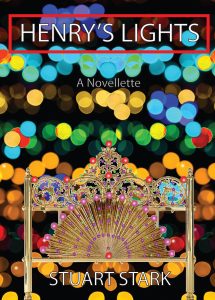
Henry’s Lights
Actually a ‘novellette’ by page count, this short story is set in west London during the 1950s, and follows one man’s obsessions over the next fifty years.
Building the West
Stuart Stark and Don Luxton developed this project to chronicle the careers of the early architects of British Columbia. Fifty-seven contributors added their knowledge and expertise to the book, bringing together, for the first time, the history – both professional and personal – of the many men, and a few women, who indeed “Built the West”. Stuart Stark contributed six essays to the authoritative 560 page volume: Victorian Pattern Books; Bungalow Pattern Books; and essays on four architects: John Gerhard Tiarks; Thomas Trounce; Samuel Cyrus Burris and Paul Phipps. The final volume was compiled and edited by Don Luxton. Building the West has won numerous awards, including: Heritage Canada Achievement Award (2003), the 2004 City of Vancouver Heritage Award of Honour, BC Book Prize, the Roderick Haig-Brown Regional Prize (2004), Architectural Institute of British Columbia Special Jury Prize (2004) and the Canadian Association of Professional Heritage Consultants Award of Honour (2004). Talon Books, Vancouver, 2003.
The Crystal Gardens: West Coast Pleasure Palace
This richly-illustrated book gives a detailed overview of an iconic west coast building: “The Finest Swimming Pool on the Continent”; that once was part of the Canadian Pacific Railway empire – the “greatest travel system in the world” at the time, encompassing trains, ships, hotels and more. Stuart Stark oversaw the compilation of the book, researched all the 201 illustrations and wrote the captions. Six contributors – writers and designers – were involved with the book: Carolyn Smyly; Terry Reksten; Alastair Kerr; Martin Segger; Stuart Stark; and Reynold Knowlton. The renowned Pierre Berton contributed a personal introduction.

 Henry’s Lights
 Building the West
 The Crystal Gardens: